Do I Need To Floss?
Get affordable dental hygiene appointments in the UK from one of 9 nationwide YDS clinics. Contact us to discuss your options and pay monthly finance today.
The experts at Yorkshire Dental Suite recommend flossing your teeth daily. When combined with toothbrushing, this action plays an essential part in the prevention of many oral health issues, including gum disease.
Do I need to floss?
The short answer is yes. By removing the food particles and bacteria that accumulates between the teeth, you are helping to prevent tooth decay, while also protecting against bad breath. Please note however that flossing does not replace toothbrushing, and should be used as part of an oral health routine.
If you don’t floss, you are not alone. A recent study carried out by Philips Sonicare found that 41% of adults neglect to floss (out of the 2,000 adults surveyed). In addition to this, a further 11% have never cleaned interdentally using floss or other products during any point of their adult lives.
What happens if I don’t floss?
Your oral health can become negatively impacted if you avoid this vital step in your everyday routine. Consequences include:
- Increased risk of cavities: Due to the lingering bacteria, plaque and tartar.
- Bad breath: Stuck food particles contribute to bad odours.
- Gum disease: One of the main causes of this condition is a build-up of plaque.
- Tender, bleeding gums: The accumulation of bacteria irritates the gums.
- Tooth discolouration: Caused by plaque, tartar and tooth decay.
Water flossers vs string floss vs interdental brushes
There are many different teeth flossing products available on the market. Unsure which is the best choice for you? Let’s compare three popular flossers in different categories to help you make an informed decision. For this data, we have awarded scores to each product. 1 is the best, while 3 is the worst.
Water flosser | String floss | Interdental brush | |
|---|---|---|---|
Effectiveness | 2 | 3 | 1 |
Affordability | 3 | 1 | 2 |
Travel friendly | 3 | 1 | 2 |
Durability | 1 | 3 | 2 |
Low time consumption | 1 | 3 | 2 |
Ease of use | 3 | 2 | 1 |
Environmental impact | 1 | 3 | 2 |
Compatibility with fixed braces | 2 | 3 | 1 |
Compatibility with dental bonding | 1 | 3 | 2 |
1 | 3 | 2 |
The floss with the lowest score, and therefore ranked as the best option by Yorkshire Dental Suite, is the interdental brush, followed by the water flosser. String floss takes last place in this ranking.
How to floss teeth
Each type of floss requires a different application technique. We have broken the methods down into a step-by-step guide.
Water flosser
- First, make sure your device is charged and the water chamber is filled to the indicated amount.
- Select your desired water pressure (if you are new to water flossers, we recommend starting with the lowest setting and working your way up).
- Place the nozzle in the mouth. Lean over a sink to minimise mess.
- Direct the water over the gumline, top of the tooth and the spaces between the teeth. Spend two seconds on each tooth.
- Repeat across the whole mouth.
- Empty the remaining water out of the chamber and clean. This prevents the growth of bacteria.
- Brush your teeth as normal.
String floss
- Break off 18 inches of floss.
- Wrap the floss around your two index fingers and pinch the thread with your thumbs to make sure it stays in place.
- Slide the floss gently between each tooth with a gentle back and forth motion. Be sure to go up and down the tooth and right up to the gumline.
- Repeat across the whole mouth. Bend the thread as needed as you go to the pre-molars and molars.
- Brush your teeth as normal.
Interdental brush
- Similar to how you would hold a pencil, hold the brush between your thumb and index finger.
- Insert the brush into the gaps between the teeth and use a light back and forth motion to clean the space. You may need a smaller brush if it gets stuck.
- Repeat this motion 2 - 3 times, before moving onto the next tooth.
- Repeat across the whole mouth.
- Brush your teeth as normal.
Other types of dental floss
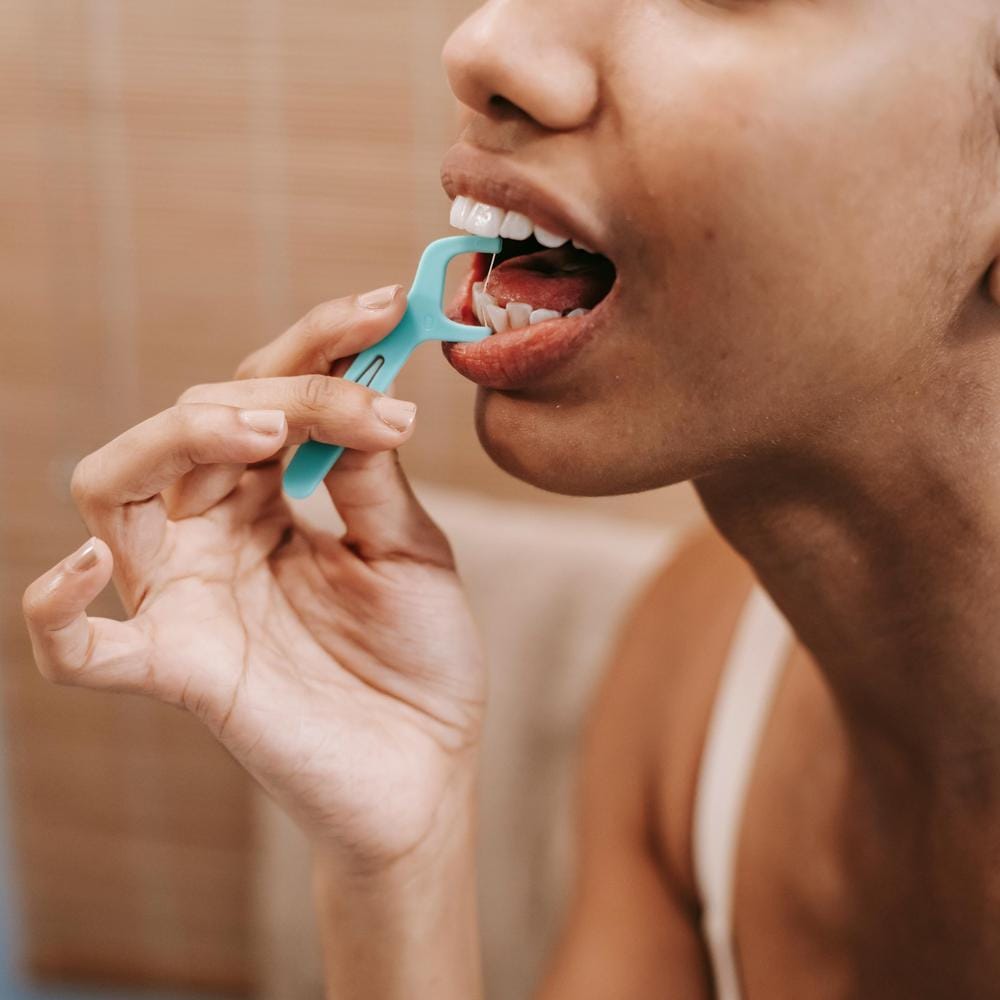
Another type of dental floss available is a floss pick. This small (typically plastic) tool has a curved head that holds a piece of floss, and is a great choice for patients with dexterity issues thanks to its ergonomic design.
Your standard string floss can also be waxed, unwaxed, flavoured and shred resistant. The choices are endless, so we recommend conducting your own research before buying based on your specific needs.
Top 10 oral health tips for healthy teeth and gums
Incorporating the following tips into your everyday routine helps to support good oral health.
- Follow the 2-2-2 rule: This means brushing your teeth twice a day for two minutes, and having two annual check-ups with your dentist
- Clean between your teeth: Flossing regularly helps to keep harmful bacteria out of your mouth.
- Do not smoke or vape: These habits pose numerous oral health risks, including mouth cancer. Smoking also accelerates discolouration.
- Consider your diet: Food and drinks that are sugary or highly acidic will wear down the enamel over time.
- Spit, don’t rinse with water: If you rinse your mouth with water immediately after brushing your teeth, you are washing away the protective fluoride from your toothpaste. Spit instead.
- Don’t forget to brush your tongue: Your tongue harbours a lot of bacteria. Brush your tongue to remove this bacteria and minimise bad breath.
- Keep hydrated: Water encourages saliva production which, in turn, protects the teeth and gums from conditions such as dry mouth.
- Use fluoride toothpastes and mouthwashes: An essential ingredient in oral health care, fluoride prevents tooth decay. It also strengthens the tooth enamel.
- Don’t ignore pain: Toothache, swollen gums, jaw pain - these are all indicators of an underlying dental issue. The longer you ignore the problem, the more severe it could become. Book an appointment with your dentist.
- Consistency is key: Maintaining great oral hygiene and considering your daily habits will support good oral health.
Conclusion:
Flossing is a key part of your oral health routine and should be carried out on a daily basis. If you have any questions about the condition of your teeth and gums, or wish to address any ongoing dental issues, contact Yorkshire Dental Suite.
References: