Dental Bridges: Implant-Retained & Fixed Bridge Treatment Options
Replace damaged or missing teeth with a dental implant bridge - contact us today to discuss your options, costs and pay monthly finance. We are a credit broker not a lender.
An implant bridge is a transformative dental treatment that restores the perfect smile you once had.
What is a fixed dental bridge?
A fixed bridge is a non-removable prosthetic device that replaces broken, worn and missing teeth. It can be attached by using existing teeth as an anchor or with dental implants. The most suitable fixed bridge for you will depend on multiple factors, including your bone density and the number of healthy teeth you have.
What is an implant-retained bridge, and how does it work?
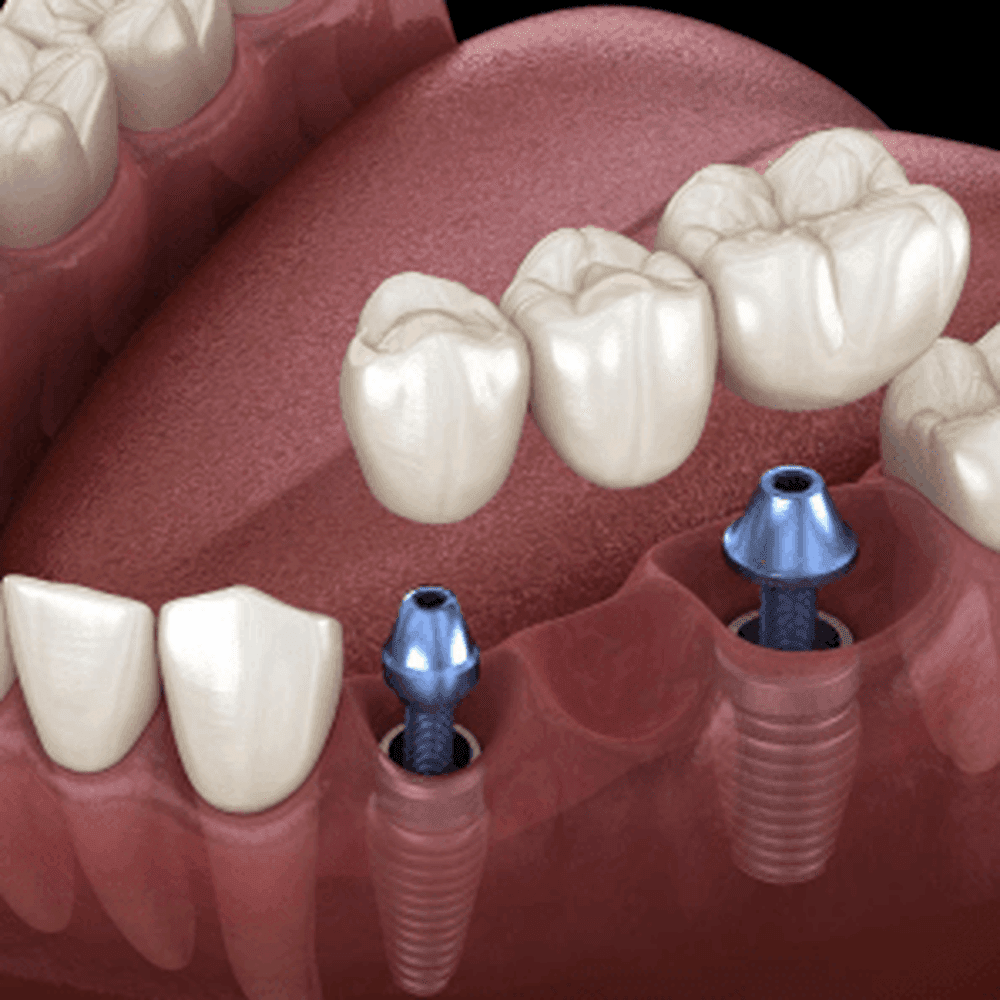
An implant bridge dental treatment can be used to replace one missing tooth or multiple adjacent teeth. The bridge is fixed in place using a dental implant, rather than attaching to the healthy teeth next to the gap and causing damage.
Implant-retained bridges are a great option for patients with little (or no) healthy teeth in the mouth. It is often the favourable choice by dentists as it does not damage the teeth next to the space you are wishing to fill.
What is a dental implant? A dental implant replaces the root of a tooth with a post made from grade 5 titanium. Surgically inserted into your jawbone, the implant is topped with a porcelain crown.
The implant bridge procedure
What does the procedure look like? The process starts with the fitting of your implant. Crafted from grade 5 titanium, the dental implant is surgically inserted into your jawbone. It then needs time to successfully integrate into your mouth (this process typically takes 3-4 months).
So, while your jawbone heals, patients will wear a temporary removable denture. After, they will return to the clinic to have their final bridge fitted. At Yorkshire Dental Suite, the price of an implant-retained bridge starts from £3,500 for 2 teeth on 1 implant.
Types of dental bridges
Instead of using a dental implant to stay in place, the following bridges use alternative methods. The bridge most suitable for you will depend on where your missing tooth is and the condition of your mouth.
Lower in cost than their implant-retained counterpart, these bridges are fixed in place using special attachments. Patients with low bone density may benefit from having one of the following fitted, as they bypass the jawbone and attach to your teeth instead.
Traditional dental bridge
Also known as a fixed partial dentures, this type of bridge fills the space left behind by a missing tooth. It attaches to the healthy adjacent teeth on both sides of the gap to stay in place.
Cantilever dental bridge
This is ideal for patients who only have a neighbouring tooth on one side of the gap for the bridge to anchor onto. It does not have the same durability as its traditional counterpart.
Maryland bridge: a dental bridge for front teeth
Uses metal wings to secure the bridge to your teeth, rather than crowns. Typically used to replace front teeth, the wings attach to the healthy adjacent teeth on both sides of the gap.
Is a fixed bridge dental treatment worth it?
No matter what type of fixed bridge you choose, the benefits are truly life changing. The prosthetic device gives you a strong, confident bite, eliminating the everyday pain you have been experiencing when eating.
The aesthetic advantages are also immeasurable. No longer do you have to hide your teeth out of embarrassment – you are able to finally smile with pride and interact with others without hiding your teeth.
Finally, a fixed bridge is one of the most long lasting dental procedures available (especially an implant-retained bridge). Your new smile can last up to 20 years with proper care. So, while the price and the idea of a surgery may be intimidating to some, the benefits are completely worth it.
Who is a good candidate for a dental bridge?
The patients who have the following are most likely suitable for this dental treatment:
- Healthy gums
- Good bone density
- Good oral health
- No gum disease present
- Over the age of 21
Additional procedures may be suggested by your dentist if you do not meet one of the aforementioned criteria. Procedures include gum grafts, bone grafts, sinus lifts and hygienist appointments. These are all available at Yorkshire Dental Suite.
Who is not a good candidate for a tooth-supported bridge?
If you do not have any adjacent teeth for the bridge to anchor onto, or the teeth are not healthy enough to support the bridge, you are not suitable for this treatment (a dental implant however may be a great alternative!). Additionally, those with gum disease will need to treat this issue prior to having their dental bridge fitted.
Finally, if you have bruxism, your eligibility can be hindered. This is because the excessive grinding and clenching of teeth caused by this habit has the ability to damage your bridge. If you have bruxism, please communicate this with your dentist.
Book your dental bridge consultation
Implant supported dental bridges fill gaps in your smile without causing damage to the adjacent teeth.
With a fixed bridge, teeth are completely transformed (as well as your quality of life). Contact Yorkshire Dental Suite and book your fixed bridge consultation today.