Dental Overlays 101
Transform your smile with a dental overlay - contact us today to discuss options, costs and pay monthly finance.
When a tooth has moderate damage or decay, a dental overlay can be used to repair it back to health. This restorative procedure is similar to an onlay, covering the cusps (the top surface) of the tooth. However, an overlay covers a larger surface area.
What are dental overlays used for?
Overlays strengthen a weakened tooth while preserving as much of its structure as possible. Think of it as the middle ground between fillings and dental crowns – when the damage is too extreme for a filling but isn’t damaged enough for a crown, your dentist may suggest fitting an overlay.
To help illustrate the purpose of an overlay and how it differs to other treatments, we have put together this table of common dental problems and which procedure would be the most suitable.
Dental issue | Do I need a dental overlay or another treatment? |
|---|---|
Mild cavity | Filling |
Severe cavity | Overlay |
Chipped tooth | Overlay or Nanofill Composite Bonding® |
Cracked tooth | Dental crown or Nanofill Composite Bonding® |
Dental trauma | Depends on the type and extent of injury – see the link for more detail |
Teeth grinding (bruxism) | Overlay, dental crown or Nanofill Composite Bonding® |
Exposed nerves | Dental crown, root canal or Nanofill Composite Bonding® |
What are dental overlays made from?
Typically, a dental overlay is made from gold, composite resin or porcelain. Here at Yorkshire Dental Suite, we have developed our very own material,
Nanofill™, to help repair your tooth. Nanofill™ is our exclusive composite resin that offers an ultra-natural look and feel. It has been meticulously crafted to provide unparalleled longevity and chip resistance, making it the perfect choice for dentists when they are repairing the top surface of the tooth.
Dental overlay procedure
If you choose to have a dental overlay with Yorkshire Dental Suite, three appointments are required to complete the treatment.
- The first appointment is a consultation. This consultation includes an oral examination, X-rays, photographs and a CT scan to check you are eligible for a dental overlay and do not have any issues that may hinder the procedure, for example, gum disease.
- At your second appointment, the main portion of the surgery is carried out. The damaged or decayed portion of the tooth is removed, and an impression of the tooth is taken and sent to the laboratory, where your permanent overlay is created. In the meantime, a temporary overlay is put in place.
- It is time to return for your third and final appointment once your permanent overlay is ready. The temporary overlay is removed, and the tooth is cleaned. Once your dentist is happy with the fit of the overlay and your bite, the final restoration is bonded to the tooth and polished to perfection.
How much does a dental overlay cost in the UK?
Are dental overlays available on the NHS? The answer is yes. As it is considered more complex than a standard filling, an overlay falls under the Band 3 category, meaning you would need to pay £332.10. However, you may face a long waiting list and limited appointment availability.
Dental overlays are also available at private clinics. The cost can vary anywhere between £400 and £900. At Yorkshire Dental Suite, the cost of a dental overlay depends on the complexity of the case but, to give you a guide, you may be looking at around £400.
We offer our patients a range of finance options to help spread the cost of their treatment. Enjoy 0% interest if you repay the amount in 24 months, or calculate finance up to five years at 9.9% APR. Rest assured, this will be discussed with you during your consultation.
How long do dental overlays last?
The lifespan of an overlay varies greatly, ranging from five years to thirty. Want to make your treatment last as long as possible? We advise you do the following:
- Keep up a great oral hygiene routine: This helps to prevent further decay and cavities. Brush your teeth with a great toothbrush and a fluoride-infused toothpaste for at least two minutes, twice a day. Flossing regularly will also stop the formation of plaque and tartar.
- If able, make changes to your diet: Overlays, like your natural teeth, are not indestructible. If possible, try to limit your intake of hard, sticky and crunchy foods to minimise the risk of damaging your dental overlay.
- Visit the dentist: We recommend attending two routine check-ups with your dentist annually to make sure your overlay and oral health is in good condition. We also recommend going to the hygienist twice a year too for a deep clean.
The pros and cons of dental overlays
Need a dental overlay? We have compiled some of the treatment’s biggest advantages and disadvantages so you are fully informed prior to the procedure.
Pros:
Overlays boast impressive durability and an ultra-aesthetic appearance. They are custom-made to fit your tooth perfectly, and also preserve more of the natural tooth structure than a filling. Another significant advantage is that an overlay diminishes the risk of future tooth damage and decay.
Cons:
As mentioned earlier, an overlay is not suitable for extreme decay or damage. It is more expensive than a typical filling, requires three appointments and may not be as widely available as fillings or crowns, due to its harder application technique. This treatment can also cause temporary sensitivity to hot and cold temperatures.
Dental overlays vs. onlays vs. inlays
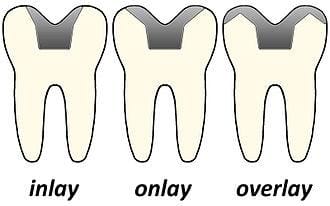
These terms are often confused. While they are all types of dental restorations, there is a key difference between the three – where they are placed on the tooth.
- Overlay: Covers the cusps and lateral surfaces of the tooth.
- Onlay: Covers the cusp (the top surface) of the tooth.
- Inlay: Fitted inside the tooth.
Conclusion:
With our state-of-the-art equipment, expert team and unparalleled attention to detail, Yorkshire Dental Suite is the best choice for your dental overlay treatment. Enquire today to restore your tooth back to health.